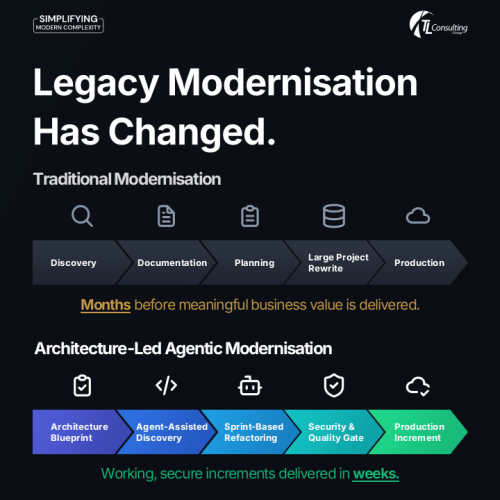
Legacy application modernisation has followed the same pattern for too long: months of discovery, heavy documentation, a fixed-scope rewrite plan, and a delivery timeline that keeps moving into the next quarter.
For Australian enterprises still running legacy .NET Framework or old Java versions, that model is becoming harder to justify. Business teams need change faster. Legacy skills are becoming harder to source. And every month spent analysing the problem is another month of technical debt and security risk building up in the background.
The complexity has not disappeared. Legacy code is still difficult. What has changed is the way teams can approach it.
GitHub Copilot and Claude, when used inside a workflow that has agents and, guided by a clear architectural blueprint, can compress the traditional assess, plan, build, and test cycle from quarters into sprints. Done properly, this does not mean cutting corners on security, maintainability, or engineering quality.
Why Legacy Migration Has Always Been Slow
The hardest part of moving from .NET Framework to .NET 8, or from Java 8 to Java 21, is rarely the destination. The real challenge is understanding what the existing system actually does.
In a 15-year-old codebase, critical business logic is often buried in unexpected places. Some dependencies are essential, while others are no longer used. Authentication patterns may be outdated. Libraries may be unsupported. Security weaknesses can sit unnoticed for years until the modernisation effort finally brings them into view.
This discovery work matters, but it has traditionally been slow, manual, and expensive.
An Architecture-Led Approach to Agentic Refactoring
Speed only helps if the work is moving in the right direction. Without clear architectural control, faster refactoring can simply create faster technical debt.
Agentic tooling works best when it is anchored to a defined target state. That means setting the reference architecture, modernisation patterns, service boundaries, data flows, authentication model, authorisation approach, and security baselines before large-scale refactoring begins.
In practice, this means applying a few clear principles.
1. Blueprint first, agents second.
Before refactoring starts, the team defines the target architecture. This includes service boundaries, data flow, authentication and authorisation patterns, and the specific frameworks being adopted, such as .NET 8 minimal APIs or Spring Boot 3.
That blueprint becomes the constraint set for Copilot and Claude. Every agent-assisted change should move the codebase towards a known target, rather than introducing inconsistent patterns across the application.
2. Codebase comprehension at scale.
Agents can assess repositories, map dependency relationships, identify deprecated or vulnerable libraries, and help shape a structured modernisation backlog in days rather than weeks.
Security findings should be treated as core backlog items, not late-stage review comments. That includes outdated authentication libraries, hardcoded secrets, and known vulnerabilities.
3. Pattern-based refactoring at volume.
Many modernisation tasks involve large numbers of structurally similar changes. Moving from ASP.NET Web Forms to Blazor or MVC, or from Java EE to Spring Boot, often requires repeated transformations across the codebase.
Agentic tooling can apply these changes consistently when it is working against an agreed blueprint. GitHub Advanced Security can then provide quality gates through secret scanning, code scanning, and dependency review on every pull request.
4. Verification at scale using tests.
Copilot and Claude can help generate characterisation tests that capture existing behaviour before refactoring begins. This gives the team a baseline for safe change. Existing tests can be updated and also used to verify that the workload’s featureset remains.
Security-focused tests can also be generated alongside functional tests, including checks around authentication boundaries and input validation. The goal is not only to preserve behaviour, but to close known gaps as part of the modernisation effort.
5. Iterative, sprint-based delivery.
The work should be broken into small, manageable increments. Each increment is refactored, tested, scanned, and validated against both the target architecture and the security baseline before it is merged.
This creates a delivery rhythm that gives stakeholders visible progress without waiting for a full rewrite to complete.
What This Looks Like in Practice
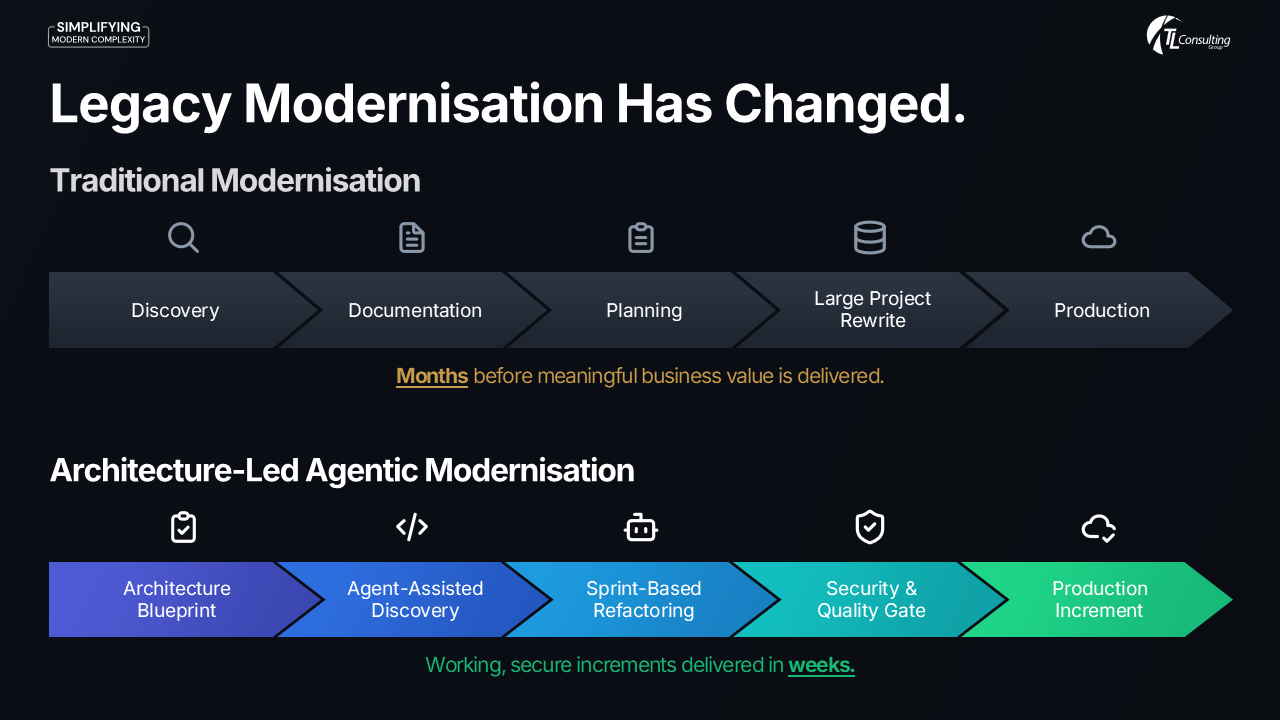
A typical engagement starts with architecture blueprinting and agent-assisted discovery in week one, including a security and dependency audit.
Weeks two to four focus on iterative refactoring sprints, each targeting a bounded slice of the application. Each slice is refactored against the blueprint, tested, scanned, and prepared for release.
By week six, the team can have a working, modernised, security-hardened increment in production, with the pattern ready to repeat across the next part of the estate.
In a traditional model, week six may still be part of discovery, with security review yet to begin.
The old model vs the new model at a glance:
Traditional Modernisation | Agentic Refactoring Model |
|---|---|
6 to 12 weeks discovery | Agent-assisted discovery in days |
Manual dependency review | Automated dependency and security analysis |
Big rewrite plan | Bounded sprint-based increments |
Security review late in the cycle | Security gates on every pull request |
Value delivered after months | Modernised slices delivered progressively |
Where TLC Fits
This approach only works when architectural discipline, tooling, and engineering execution come together.
Using Copilot on a legacy codebase without a blueprint, security controls, or quality gates does not create modernisation. It creates noise, and often more technical debt.
TLC brings these elements together through our GitHub Advanced Partner capability across Copilot and GitHub Advanced Security, combined with hands-on experience in Platform Engineering, DevSecOps, and solution architecture.
Our role is to define the target-state blueprint, embed security scanning into every agentic workflow, and turn AI-assisted coding into a repeatable, governed modernisation approach.
Move Legacy Modernisation from Roadmap to Delivery.
If your legacy .NET or Java estate has been deferred, now is the time to reassess. With agentic refactoring and the right architectural approach, modernisation can move from roadmap intent to practical delivery this quarter.
Partner funding may also be available to support eligible modernisation initiatives.