For the past two years, most of the AI conversation has been about frontier models. Bigger models, bigger benchmarks, bigger price tags. But something else has been happening quietly in the background.
Open-source models are improving fast, and the gap between frontier and open models is closing quicker than most people expected. For a lot of software engineering and enterprise use cases, the question isn’t “can an open model do the job” anymore. It’s “when is it the right model for the task.”
That’s where GitHub Copilot comes in.
It's No Longer About Choosing One Model
Modern AI development isn’t about locking into one model provider anymore. It’s about picking the right model for the task at hand.
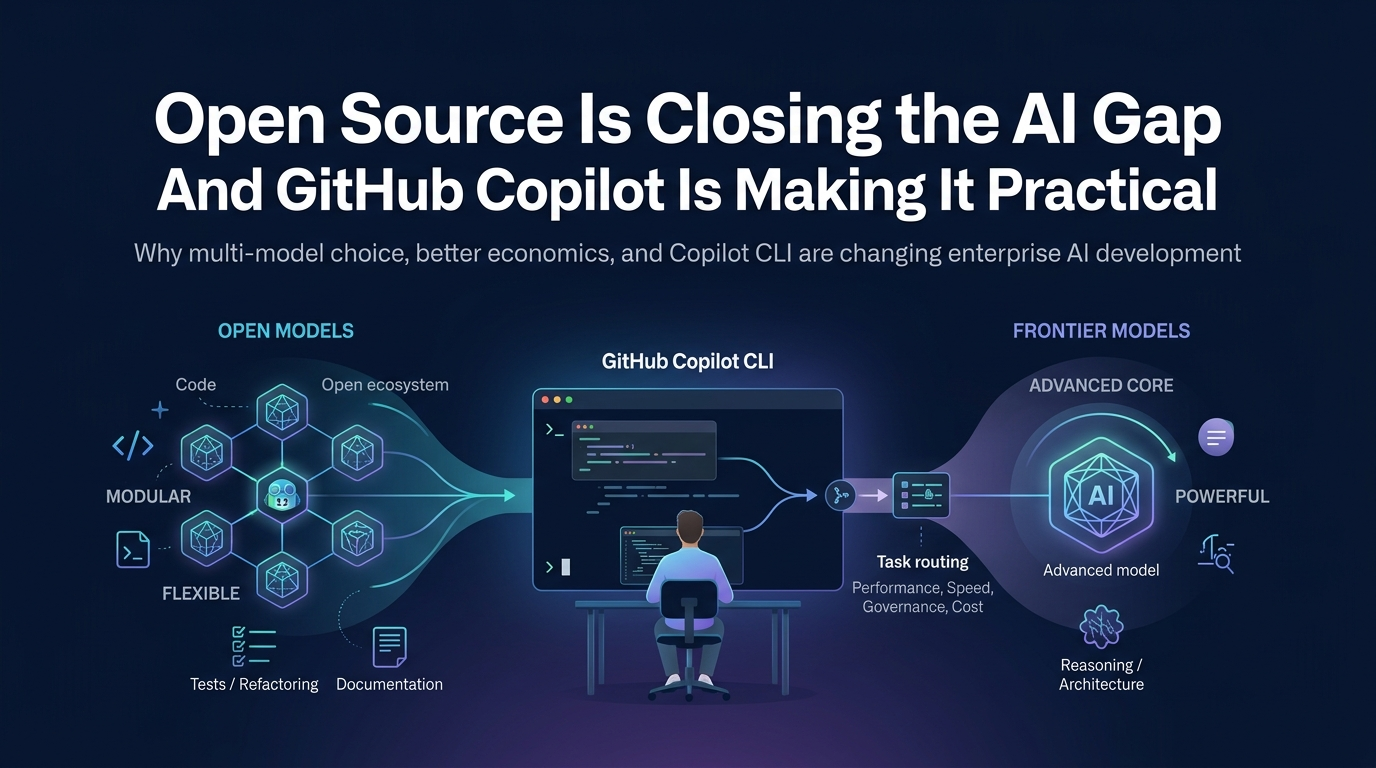
- For deep architectural reasoning, reach for a frontier model.
- For boilerplate code, refactoring, tests, documentation and other repetitive tasks, an open-source model can often do just as good a job, for a fraction of the token cost.
GitHub’s growing model ecosystem reflects this shift. Recent additions like Kimi K2.7 show that developers now have a genuinely expanding portfolio of models to choose from, rather than being locked into one AI experience.
That flexibility matters more as organisations start tracking AI usage through consumption-based pricing.
GitHub Copilot CLI Changes the Economics
One of the more useful developments here is GitHub Copilot CLI.
The terminal is where developers spend a lot of their day. It’s now becoming a smarter workspace, one that can direct AI assistance to exactly where it’s needed.
Rather than sending every request to the biggest, most expensive model available, developers can use different models depending on how complex the task is. GitHub’s multi-model approach lets engineering teams balance capability, speed and cost, without changing how they work.
This has real commercial implications too. As AI shifts towards usage-based billing, token efficiency starts to matter a lot.
Open-source models are proving to be an effective way to strike that balance.
The Gap Is Shrinking
The pace of improvement from the open-source community has been genuinely impressive. Projects from Moonshot AI, Meta, Alibaba, Mistral and others keep raising the bar for what open models can do.
Kimi’s rapid evolution is one recent example of how open-weight models are becoming highly competitive in coding, reasoning, and agentic workflows while remaining significantly more accessible than many proprietary alternatives.
They probably won’t replace frontier models, but they don’t need to.
The future is increasingly becoming a hybrid ecosystem, where organisations intelligently combine frontier and open models according to workload, governance requirements, latency, and cost.
The Platform Matters More Than the Model
More Choice, Better Economics
The AI race isn’t simply about building the largest model anymore. It’s about giving developers choice:
- Choice to balance performance with cost.
- Choice to optimise token consumption.
- Choice to adopt open innovation alongside frontier capability.
GitHub Copilot, and its expanding CLI experience in particular, is showing that the future isn’t proprietary or open source. It’s both.
For engineering leaders, that’s an exciting proposition. It means AI can become more scalable, more economical, and more adaptable as new models are released. And with open-source innovation accelerating at an incredible rate, the gap between “good enough” and “best available” continues to narrow.
The result is more choice, better economics, and a developer experience that keeps getting better as the market does.
Not sure where your AI development gaps are?
TL Consulting Group offers a complimentary consultation to baseline your engineering team's AI maturity. We help identify the right mix of frontier and open-source models for your workflows, assess your Copilot setup, and clarify practical next steps.